

Machine learning and other gibberish
See also: https://sharing.leima.is
Archives: https://datumorphism.leima.is/amneumarkt/
See also: https://sharing.leima.is
Archives: https://datumorphism.leima.is/amneumarkt/
#python
Our internet is broken again, and this time by Python setuptools.
[BUG] Version 78.0.1 breaks install of ansible-vault package · Issue #4910 · pypa/setuptools
https://github.com/pypa/setuptools/issues/4910
Our internet is broken again, and this time by Python setuptools.
[BUG] Version 78.0.1 breaks install of ansible-vault package · Issue #4910 · pypa/setuptools
https://github.com/pypa/setuptools/issues/4910
#python
I had the wrong idea for a long time that IDEs treat method/function without return type hint as returning None type.
I was wrong. In PEP484, it says IDE should treat such a method/function as a type that is as general as possible. Ah that just makes sense.
https://peps.python.org/pep-0484/#the-meaning-of-annotations
I had the wrong idea for a long time that IDEs treat method/function without return type hint as returning None type.
I was wrong. In PEP484, it says IDE should treat such a method/function as a type that is as general as possible. Ah that just makes sense.
https://peps.python.org/pep-0484/#the-meaning-of-annotations
#python
Guidelines for research coding. It is not the highest standard but is easy to follow.
https://goodresearch.dev/
Guidelines for research coding. It is not the highest standard but is easy to follow.
https://goodresearch.dev/
#python
This post is a retro on how I learned Python.
Disclaimer: I can not claim that I am a master of Python. This post is a retrospective of how I learned Python in different stages.
I started using Python back in 2012. Before this, I was mostly a Matlab/C user.
Python is easy to get started, yet it is hard to master. People coming from other languages can easily make it work but will write some "disgusting" python code. And this is because Python people talk about "pythonic" all the time. Instead of being an actual style guide, it is rather a philosophy of styles.
When we get started, we are most likely not interested in [PEP8](https://peps.python.org/pep-0008/) and [PEP257](https://peps.python.org/pep-0257/). Instead, we focus on making things work. After some lectures from the university (or whatever sources), we started to get some sense of styles. Following these lectures, people will probably write code and use Python in some projects. Then we began to realize that Python is strange, sometimes even doesn't make sense. Then we started leaning about the philosophy behind it. At some point, we will get some peer reviews and probably fight against each other on some philosophies we accumulated throughout the years.
The attached drawing (in comments) somehow captures this path that I went through. It is not a monotonic path of any sort. This path is most likely to be permutation invariant and cyclic. But the bottom line is that mastering Python requires a lot of struggle, fights, and relearning. And one of the most effective methods is peer review, just as in any other learning task in our life.
Peer review makes us think, and it is very important to find some good reviewers. Don't just stay in a silo and admire our own code. To me, the whole journey helped me building one of the most important philosophies of my life: embrace open source and collaborate.
This post is a retro on how I learned Python.
Disclaimer: I can not claim that I am a master of Python. This post is a retrospective of how I learned Python in different stages.
I started using Python back in 2012. Before this, I was mostly a Matlab/C user.
Python is easy to get started, yet it is hard to master. People coming from other languages can easily make it work but will write some "disgusting" python code. And this is because Python people talk about "pythonic" all the time. Instead of being an actual style guide, it is rather a philosophy of styles.
When we get started, we are most likely not interested in [PEP8](https://peps.python.org/pep-0008/) and [PEP257](https://peps.python.org/pep-0257/). Instead, we focus on making things work. After some lectures from the university (or whatever sources), we started to get some sense of styles. Following these lectures, people will probably write code and use Python in some projects. Then we began to realize that Python is strange, sometimes even doesn't make sense. Then we started leaning about the philosophy behind it. At some point, we will get some peer reviews and probably fight against each other on some philosophies we accumulated throughout the years.
The attached drawing (in comments) somehow captures this path that I went through. It is not a monotonic path of any sort. This path is most likely to be permutation invariant and cyclic. But the bottom line is that mastering Python requires a lot of struggle, fights, and relearning. And one of the most effective methods is peer review, just as in any other learning task in our life.
Peer review makes us think, and it is very important to find some good reviewers. Don't just stay in a silo and admire our own code. To me, the whole journey helped me building one of the most important philosophies of my life: embrace open source and collaborate.
#python
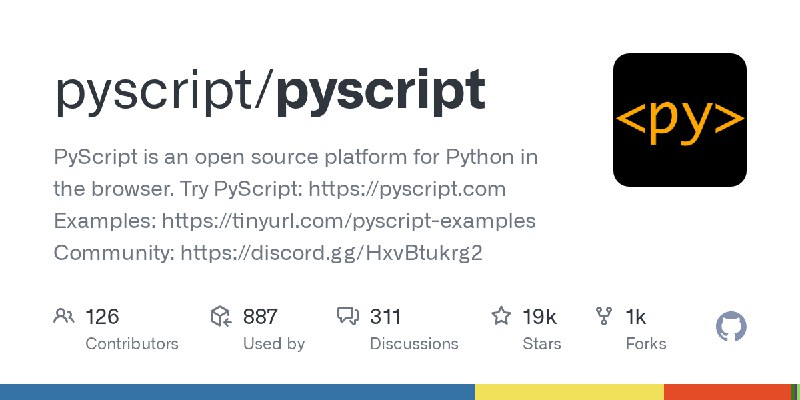
Anaconda open sourced this...
I have no idea what this is for...
https://github.com/pyscript/pyscript
Anaconda open sourced this...
I have no idea what this is for...
https://github.com/pyscript/pyscript
#python
I find poetry a great tool to manage Python requirements.
I used to manage Python requirements using requirements.txt(environment.yaml) and install them using pip(conda). The thing is, in this stack, we have to pin the version ranges manually. It is quite tedious, and we easily run into version problems for a large project.
Poetry is the savior here. When developing a package, we add some initial dependencies to the pyproject.yaml, a PEP standard. Whenever a new package is needed, we run poetry add package-name. Poetry tries to figure out the compatible versions. A lock file for the dependencies with restricted versions will be created or updated. To recreate an identical python environment, we only need to run poetry install.
There's one drawback and may be quite painful at some point. Recreating the lock file for dependencies is extremely slow when the complexity grows in the requirements. But this is not a problem if poetry but rather constraints from pypi. One solution to this problem is to use cache.
https://python-poetry.org/
I find poetry a great tool to manage Python requirements.
I used to manage Python requirements using requirements.txt(environment.yaml) and install them using pip(conda). The thing is, in this stack, we have to pin the version ranges manually. It is quite tedious, and we easily run into version problems for a large project.
Poetry is the savior here. When developing a package, we add some initial dependencies to the pyproject.yaml, a PEP standard. Whenever a new package is needed, we run poetry add package-name. Poetry tries to figure out the compatible versions. A lock file for the dependencies with restricted versions will be created or updated. To recreate an identical python environment, we only need to run poetry install.
There's one drawback and may be quite painful at some point. Recreating the lock file for dependencies is extremely slow when the complexity grows in the requirements. But this is not a problem if poetry but rather constraints from pypi. One solution to this problem is to use cache.
https://python-poetry.org/
#python
I thought it was a trivial talk in the beginning.
But I quickly realized that I may know every each piece of the code mentioned in the video but the philosophy is what makes it exciting.
He talked about some fundamental ideas of Python, e.g., protocols.
After watching this video, an idea came to me. Pytorch lightning has implanted a lot of hooks in a very pythonic way. This is what makes pytorch lightning easy to use. (So if you do a lot of machine learning experiments, pytorch lightning is worth a try.)
https://youtu.be/cKPlPJyQrt4
I thought it was a trivial talk in the beginning.
But I quickly realized that I may know every each piece of the code mentioned in the video but the philosophy is what makes it exciting.
He talked about some fundamental ideas of Python, e.g., protocols.
After watching this video, an idea came to me. Pytorch lightning has implanted a lot of hooks in a very pythonic way. This is what makes pytorch lightning easy to use. (So if you do a lot of machine learning experiments, pytorch lightning is worth a try.)
https://youtu.be/cKPlPJyQrt4
